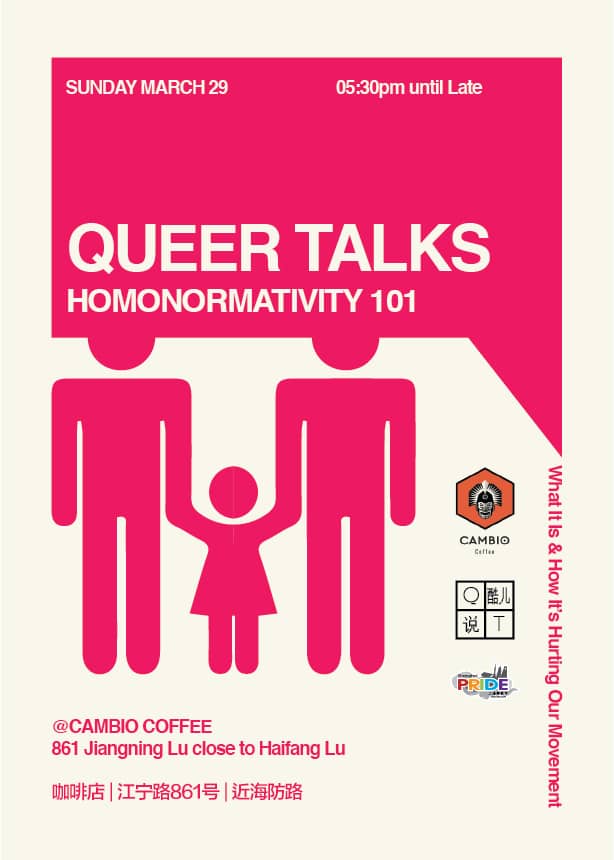

ShanghaiPRIDE presents Queer Talks #1: Homonormativity 101
When: Sunday 29March2015 5:30pm
Where: Cambio Coffee – 861 Jiangning Lu near Haifang Lu
Entry: Free, RSVP [email protected]
Please support the venue by buying at least a beverage.
Homonormativity 101: What It Is and How It’s Hurting Our Movement
Used to describe something that’s been around much longer than the word itself, the phenomenon of homonormativity is considered by many to be destructive to the queer rights movement and to the larger queer community.
Homonormativity is a word that addresses the problems of privilege we see in the queer community today as they intersect with White privilege, capitalism, sexism, transmisogyny, and cissexism, all of which end up leaving many people out of the movement toward greater sexual freedom and equality.
So what does it mean, and more importantly, how does it manifest in our everyday lives?
First, let’s examine it’s counterpart, heteronormativity. This is a word that similarly describes the evaluation of “normal” sexuality that we see in our culture, from the policy and institutional level down to the interpersonal, privileging those who fit the norm and positing anyone outside of this as abnormal and wrong.
Our culture is deeply heteronormative, but as queer experiences and rights become more accepted, a policing of sexual and gender expressions within LGBTQIA spaces is also growing. This is homonormativity.
Homonormativity explains how certain aspects of the queer community can perpetuate assumptions, values, and behaviors that hurt and marginalize many folks within this community, as well as those with whom the community should be working in solidarity. It addresses assimilation, as well as intersection of corporate interests and consumerism within LGBTQIA spaces.
It also describes the assumption that queer people want to be a part of the dominant, mainstream, heterosexual culture, and the way in which our society rewards those who do so, identifying them as most worthy and deserving of visibility and rights.
As social attitudes change around queer relationships, we’re seeing more representations of queer people in the media, though this representation is incredibly limited.
Turn on the TV or flip through a magazine – for each of the few times that you’ll see a queer person, they’ll more than likely be a cisgender, gender-normative, White, middle class, gay-identifying person.
The kinds of queer relationships we see represented in the media are also limiting, in that they tend to mimic heteronormative binary gender expressions and are often based on stereotypes.
The stereotypes and tropes of LGBTQIA people in media do more than simplify and minimize the complex realities of queer people; they participate in setting up a standard of a normative way to “be” LGBTQIA. They do so reproducing, rather than challenging, heterosexual dominance and normativity and using this as a basis for who deserves rights.
Adapted from “Homonormativity 101: What It Is and How It’s Hurting Our Movement” by Laura Kacere for Everyday Feminism.
http://everydayfeminism.com/2015/01/homonormativity-101/